
18:04Machine-translated from Azerbaijani by AIRead in Azerbaijani
AI Increases LTO Tape Storage Shipments by 57%

LTO Program technology providers HPE, IBM and Quantum announced that the tape storage capacity shipped in the first quarter of 2026 increased by 57% compared with the same period in 2025. The increase is mainly attributed to the rapidly growing storage needs of artificial intelligence data centers. Demand for traditional archiving and cyber-resilient backups also contributed to the result. A total of 160.3 exabytes of tape storage was shipped in 2025. The figure was calculated on a compressed-capacity basis and was 9% lower than in 2024. Nevertheless, it was the second-highest result in LTO history. The record was set in 2024 at 176.5 exabytes. Growth that year was 15.4%. The market’s readiness for LTO-9 and the initial rollout of LTO-10 also contributed to the increase at the beginning of 2026. An LTO-9 cartridge can store 18 TB of uncompressed data and 45 TB of compressed data. With the new LTO-10, these figures reach 40 TB and 100 TB, respectively. This makes it possible to fit more than twice as much data on a single cartridge compared with the previous generation.
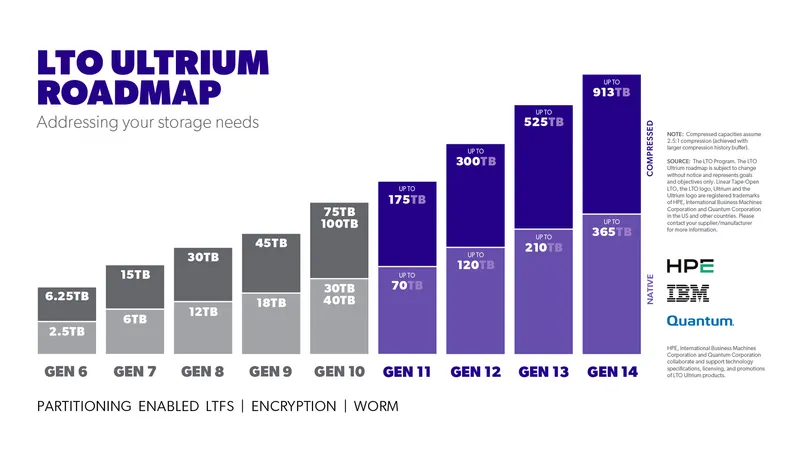 The format’s development roadmap now extends through the LTO-14 generation. The future cartridge is planned to offer a capacity of 576 TB uncompressed and 1,440 TB compressed. In this way, manufacturers are seeking to keep tape storage relevant for large-scale, long-term archives. These figures are not the capabilities of a finished product but capacity targets set for a future generation. Quantum CEO Hugues Meyrath said the unprecedented rate of data growth is intensifying pressures related to cost, energy consumption and cyber resilience. Tape storage stands out for its low cost per terabyte, high energy efficiency and predictable costs for long-term storage. These features keep LTO tapes relevant for modern data infrastructure and backup systems.
A total of 160.3 exabytes of tape storage was shipped in 2025. The figure was calculated on a compressed-capacity basis and was 9% lower than in 2024. Nevertheless, it was the second-highest result in LTO history. The record was set in 2024 at 176.5 exabytes. Growth that year was 15.4%. The market’s readiness for LTO-9 and the initial rollout of LTO-10 also contributed to the increase at the beginning of 2026. An LTO-9 cartridge can store 18 TB of uncompressed data and 45 TB of compressed data. With the new LTO-10, these figures reach 40 TB and 100 TB, respectively. This makes it possible to fit more than twice as much data on a single cartridge compared with the previous generation. The format’s development roadmap now extends through the LTO-14 generation. The future cartridge is planned to offer a capacity of 576 TB uncompressed and 1,440 TB compressed. In this way, manufacturers are seeking to keep tape storage relevant for large-scale, long-term archives. These figures are not the capabilities of a finished product but capacity targets set for a future generation. Quantum CEO Hugues Meyrath said the unprecedented rate of data growth is intensifying pressures related to cost, energy consumption and cyber resilience. Tape storage stands out for its low cost per terabyte, high energy efficiency and predictable costs for long-term storage. These features keep LTO tapes relevant for modern data infrastructure and backup systems.