
09:10Machine-translated from Azerbaijani by AIRead in Azerbaijani
Anthropic Unveils Claude Sonnet 5.5 AI Model That Cuts Costs by Up to 30%
Anthropic has released the Claude Sonnet 5.5 artificial intelligence model. The new model, the 2nd in the Claude 5.5 family, was released less than 1 week after Claude Opus 5.5. According to the company, the model is more than 30% faster than Sonnet 5. Because it completes the same tasks by processing fewer tokens, meaning fewer units of text, costs are also reduced by up to 30%.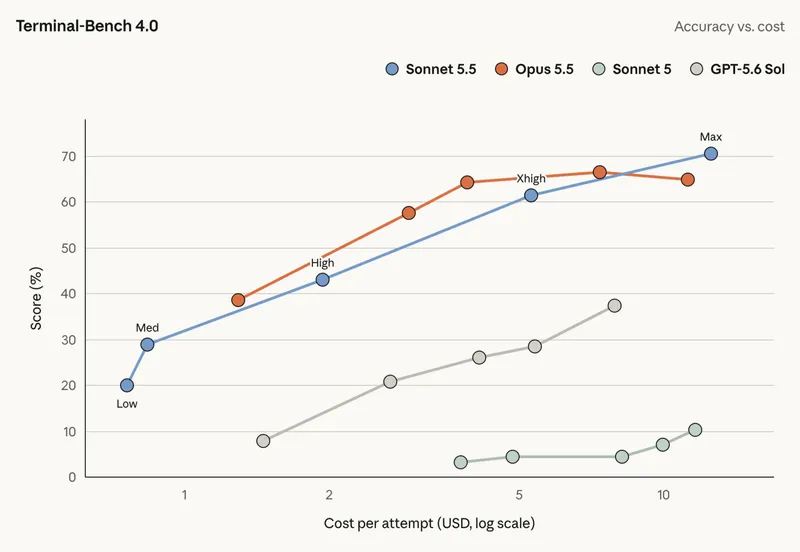 The new model replaces Sonnet 5, which was introduced in June. In Anthropic's model lineup, Haiku is the smaller option, Sonnet is the midrange option, and Opus is the more powerful and expensive option. Fable/Mythos is considered the company's highest-tier model. An updated Claude Haiku 5.5 is expected to be released in the coming weeks, but an exact date has not yet been announced. Claude Sonnet 5.5 is designed for routine work whose scope is clearly defined in advance. The model can fix errors in software code and create documents, presentations and spreadsheets. It can also improve user interfaces and create slides that follow a provided template. Anthropic presents it as a cheaper alternative to Opus 5.5, which is designed for more complex, open-ended tasks. Claude Sonnet 5.5 scored 1,844 points on the GDPval-AA v2.1 test. This was 2 points below Opus 5.5 and approximately 400 points above the previous Sonnet 5 model. It became the first Sonnet model to complete Pokémon Red using only screenshots. It outperformed Opus 5.5 in agentic coding, where it plans and completes tasks on its own. However, Opus 5.5 remained more powerful on most other complex tasks. In Slack's tests, the new model completed tasks in fewer steps and used approximately 14% fewer output tokens. Participants said it wrote more clearly and was easier to work with when making quick revisions. Anthropic emphasizes that these results do not demonstrate all of the model's capabilities. A token is a small portion of the text processed by the model. As the number of tokens decreases, the cost of using the model also falls.
 Prices per 1 million tokens have not changed. Input tokens cost $2 (approximately AZN 3). Output tokens cost $10 (approximately AZN 17). Tokens read from a previously stored cache cost $0.20 (approximately AZN 0.34). The model runs across all Anthropic platforms, including Amazon Web Services, Google Cloud and Microsoft Azure. Developers can select the name claude-sonnet-5-5 in the API. Those who disable thinking mode must update the between_tools parameter before migrating. Because the model's cybersecurity capabilities are close to those of Opus 5, stricter safeguards have been added. High-risk prompts will automatically be routed to Sonnet 5. Routine software bug fixes will not be affected. The safeguards for biology remain the same as in the previous model. In tests covering approximately 1,850 scenarios, the model matched or surpassed Sonnet 5 on most metrics. Opus 5.5 held a narrow overall lead.
The new model replaces Sonnet 5, which was introduced in June. In Anthropic's model lineup, Haiku is the smaller option, Sonnet is the midrange option, and Opus is the more powerful and expensive option. Fable/Mythos is considered the company's highest-tier model. An updated Claude Haiku 5.5 is expected to be released in the coming weeks, but an exact date has not yet been announced. Claude Sonnet 5.5 is designed for routine work whose scope is clearly defined in advance. The model can fix errors in software code and create documents, presentations and spreadsheets. It can also improve user interfaces and create slides that follow a provided template. Anthropic presents it as a cheaper alternative to Opus 5.5, which is designed for more complex, open-ended tasks. Claude Sonnet 5.5 scored 1,844 points on the GDPval-AA v2.1 test. This was 2 points below Opus 5.5 and approximately 400 points above the previous Sonnet 5 model. It became the first Sonnet model to complete Pokémon Red using only screenshots. It outperformed Opus 5.5 in agentic coding, where it plans and completes tasks on its own. However, Opus 5.5 remained more powerful on most other complex tasks. In Slack's tests, the new model completed tasks in fewer steps and used approximately 14% fewer output tokens. Participants said it wrote more clearly and was easier to work with when making quick revisions. Anthropic emphasizes that these results do not demonstrate all of the model's capabilities. A token is a small portion of the text processed by the model. As the number of tokens decreases, the cost of using the model also falls. Prices per 1 million tokens have not changed. Input tokens cost $2 (approximately AZN 3). Output tokens cost $10 (approximately AZN 17). Tokens read from a previously stored cache cost $0.20 (approximately AZN 0.34). The model runs across all Anthropic platforms, including Amazon Web Services, Google Cloud and Microsoft Azure. Developers can select the name claude-sonnet-5-5 in the API. Those who disable thinking mode must update the between_tools parameter before migrating. Because the model's cybersecurity capabilities are close to those of Opus 5, stricter safeguards have been added. High-risk prompts will automatically be routed to Sonnet 5. Routine software bug fixes will not be affected. The safeguards for biology remain the same as in the previous model. In tests covering approximately 1,850 scenarios, the model matched or surpassed Sonnet 5 on most metrics. Opus 5.5 held a narrow overall lead.