
17:34Machine-translated from Azerbaijani by AIRead in Azerbaijani
Anthropic Unveils Claude Sonnet 5.5 With Reduced Token Usage

Anthropic has unveiled Claude Sonnet 5.5, the second model in its current family of 5.5-generation artificial intelligence models. The new model is designed to balance speed and computational efficiency for everyday tasks, programming, document analysis, and creating presentations.
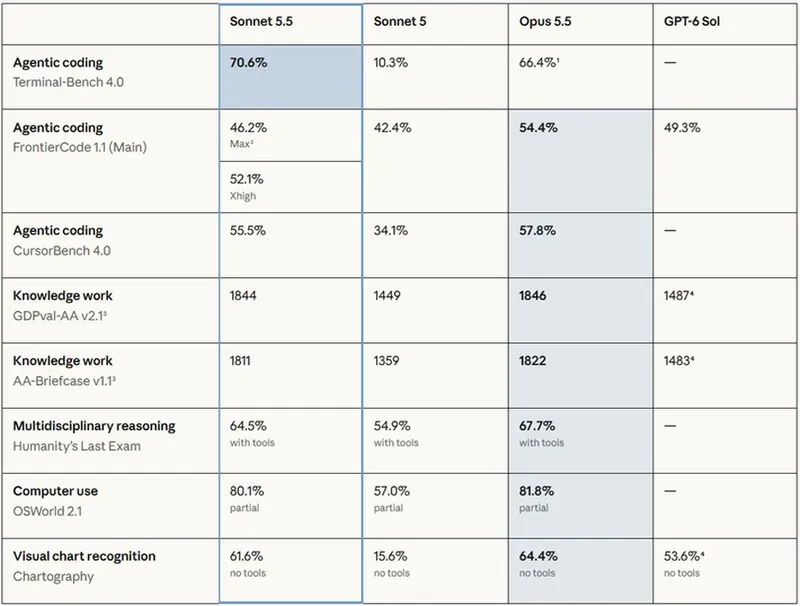
The main innovation in Claude Sonnet 5.5 is its higher performance compared with the previous Claude Sonnet 5 while requiring less computation to perform tasks. Because the model uses external tools more efficiently, it takes fewer steps when processing complex code repositories.
According to Anthropic, Sonnet 5.5 generates responses more than 30% faster than the previous version and costs up to 30% less in most scenarios because it uses fewer tokens to do the same work.
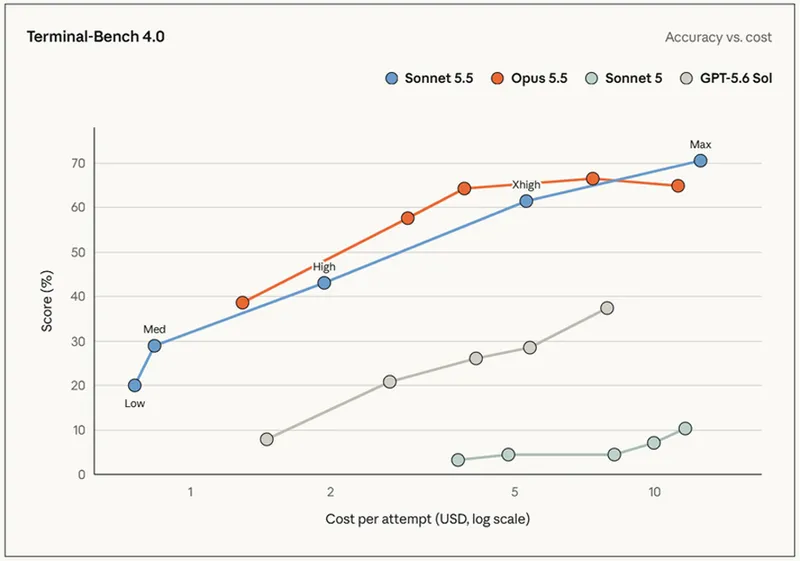
Benchmark results released by the company also show that the model has made significant progress over the previous generation. In Terminal-Bench 4.0, which tests programming skills, Sonnet 5.5 scored 70.6%, while Sonnet 5 scored only 10.3%. The new model scored 55.5% in CursorBench 4.0. By comparison, Sonnet 5 scored 34.1%, while the flagship Claude Opus 5.5 model scored 57.8%. Sonnet 5.5 scored 1,844 points in GDPval-AA, which evaluates the completion of professional tasks. This is almost on par with Opus 5.5, which scored 1,846 points. In OSWorld 2.1, which tests automated computer control, Sonnet 5.5 scored 80.1%. This is just 1.7 percentage points below the flagship model.
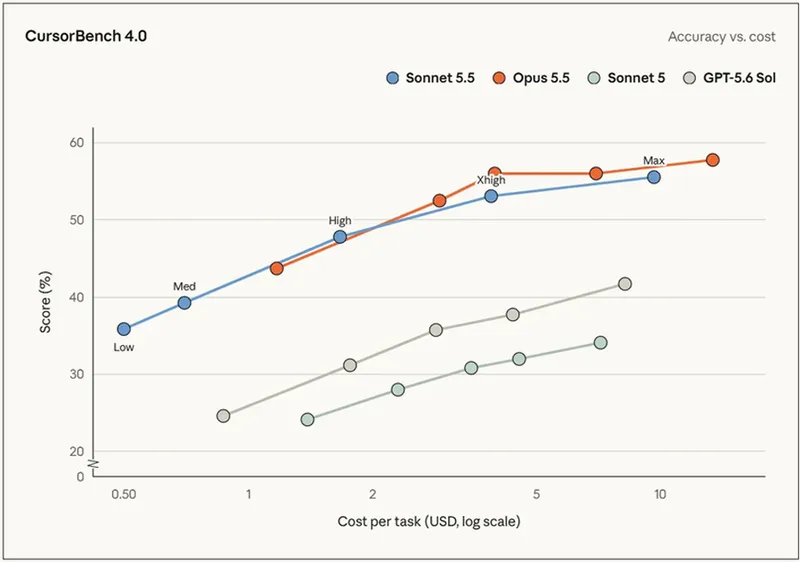
Anthropic says overall token usage has also decreased in real-world use of the model. This allows complex tasks to be completed with fewer computing resources and, consequently, at a lower cost. However, official API pricing for Claude Sonnet 5.5 remains unchanged: $2 per 1 million input tokens and $10 per 1 million output tokens.
Claude Sonnet 5.5 is now available through Anthropic’s official website and Claude apps, as well as on the Amazon Web Services, Google Cloud, and Microsoft Azure platforms.