
19:16Machine-translated from Azerbaijani by AIRead in Azerbaijani
ChatGPT to Begin Marking AI-Generated Text With Invisible “Watermarks”
OpenAI is beginning to roll out a new technology in ChatGPT and Codex that makes it possible to determine whether text was created by artificial intelligence. The system, called textGrain, adds no visible markings to the text but creates a statistical trace within the response that can later be detected by a special detector.
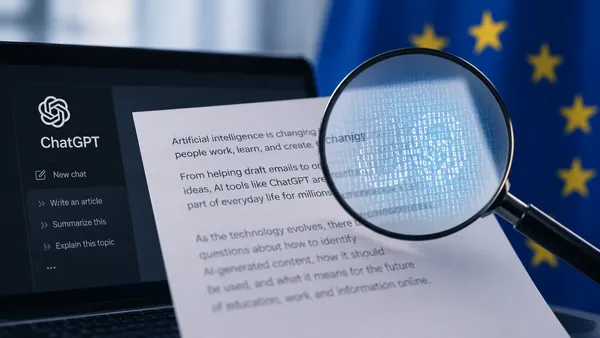
Interestingly, textGrain does not work like a conventional “hidden watermark.” The system does not insert invisible characters, extra spaces, or unusual punctuation into the text. Instead, it slightly alters the probability of selecting words and parts of words as the model generates a response. As a result, a statistical pattern emerges within the text that cannot be seen by the human eye but can be identified by a special algorithm.
For users in the European Union, this marking will become mandatory in ChatGPT and Codex in the coming weeks. Customers using the OpenAI API will be able to enable the feature themselves on supported models anywhere in the world. The system will initially be disabled in the API. However, the technology’s accuracy depends heavily on the length and content of the text. Short responses are more difficult to identify, while the detector is less effective with mathematical and other formal texts.
In one of OpenAI’s tests, with the false-positive rate kept at 1%, textGrain was able to detect the AI marker in 80% of texts containing about 200 tokens and approximately 95% of texts containing 400 tokens. However, subsequently editing the text can sharply reduce this figure. For example, in 400-token texts, replacing just 10% of the words with synonyms reduced the detection rate from an average of 92% to 66%. When 25% of the words were changed, the figure fell to just 17%.
Initially, only researchers and specialized organizations approved by OpenAI will be able to test the textGrain technology. The company plans to make the technology available to other developers as well in the future.