
14:43Machine-translated from Azerbaijani by AIRead in Azerbaijani
Coinbase Engineer Turns Fruit Fly Brain Simulation Into a Crypto Trader
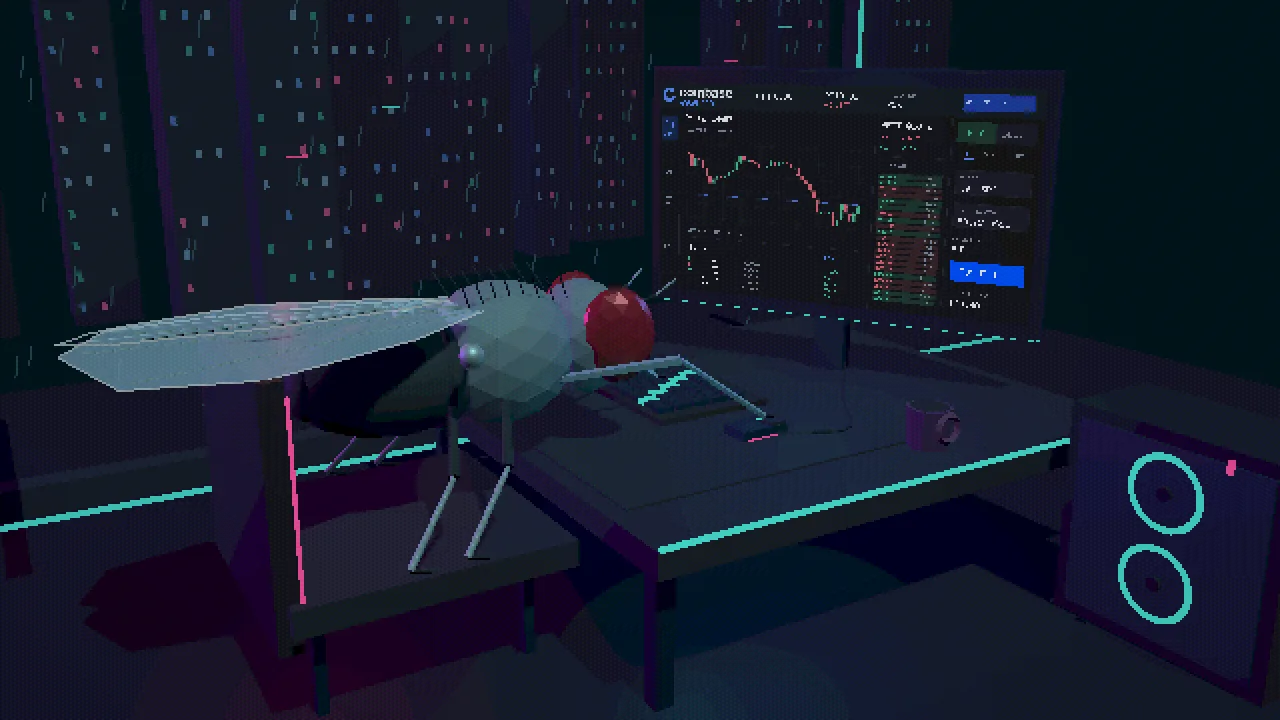
An engineer at Coinbase has turned a simulation of a male fruit fly’s brain and eyes into a cryptocurrency trader. In the project, called Stonkfly, the virtual fly is shown a candlestick chart depicting how the price changed in previous periods. The simulation looks at the chart and decides whether to buy, sell or hold the currency. The project’s code is publicly available and can be downloaded from GitHub. The virtual fly views cryptocurrency charts one at a time and receives a reward signal for a profitable trade. When the portfolio—the total value of the assets in the account—increases, dopamine is transmitted to 15 cells. When there is a loss, 2 cells that represent an aversive response are activated. Transaction fees are also counted as losses. The creator emphasizes that the simulation has no mechanisms related to pain or emotions. The virtual brain has 166,700 neurons and 25.6 million connections. The fly’s left and right eyes see the chart as overlapping images measuring 320 x 180 and centered on the same point. The light-sensitive cells in the eyes perceive the red, green and blue (RGB) values of the pixels rather than the price itself. The simulation makes a decision every 500 milliseconds, or every half second. Market data is updated every 60 seconds. Stonkfly can make up to 24 trades per day. It can allocate $10 (approximately 17 AZN) to each trade.
 The simulation cannot borrow money to trade larger amounts or bet that the price will fall. According to the creator, the experiment merely demonstrates the connection between incoming data, visual signals and changes in neural connections. It does not prove that the virtual fly can trade successfully in a real market. When cryptocurrency prices are generally rising, any system that simply buys can appear successful. The results therefore should not be used to make investment decisions. Under its default settings, the program does not use real money. Test trades are conducted with a virtual balance of $100 (approximately 170 AZN), while prices are taken from real BTC and USDC market data. A computer must have 16 GB of RAM to run the Stonkfly project on macOS or Linux. Python 3.11 and a C++17 compiler are also required. The code also includes instructions for connecting a live account and testing the simulation with real trades.
The virtual fly views cryptocurrency charts one at a time and receives a reward signal for a profitable trade. When the portfolio—the total value of the assets in the account—increases, dopamine is transmitted to 15 cells. When there is a loss, 2 cells that represent an aversive response are activated. Transaction fees are also counted as losses. The creator emphasizes that the simulation has no mechanisms related to pain or emotions. The virtual brain has 166,700 neurons and 25.6 million connections. The fly’s left and right eyes see the chart as overlapping images measuring 320 x 180 and centered on the same point. The light-sensitive cells in the eyes perceive the red, green and blue (RGB) values of the pixels rather than the price itself. The simulation makes a decision every 500 milliseconds, or every half second. Market data is updated every 60 seconds. Stonkfly can make up to 24 trades per day. It can allocate $10 (approximately 17 AZN) to each trade. The simulation cannot borrow money to trade larger amounts or bet that the price will fall. According to the creator, the experiment merely demonstrates the connection between incoming data, visual signals and changes in neural connections. It does not prove that the virtual fly can trade successfully in a real market. When cryptocurrency prices are generally rising, any system that simply buys can appear successful. The results therefore should not be used to make investment decisions. Under its default settings, the program does not use real money. Test trades are conducted with a virtual balance of $100 (approximately 170 AZN), while prices are taken from real BTC and USDC market data. A computer must have 16 GB of RAM to run the Stonkfly project on macOS or Linux. Python 3.11 and a C++17 compiler are also required. The code also includes instructions for connecting a live account and testing the simulation with real trades.