
13:37Machine-translated from Azerbaijani by AIRead in Azerbaijani
DeepMind's 4 Gemini AI Agents Beat Minecraft Without Human Help
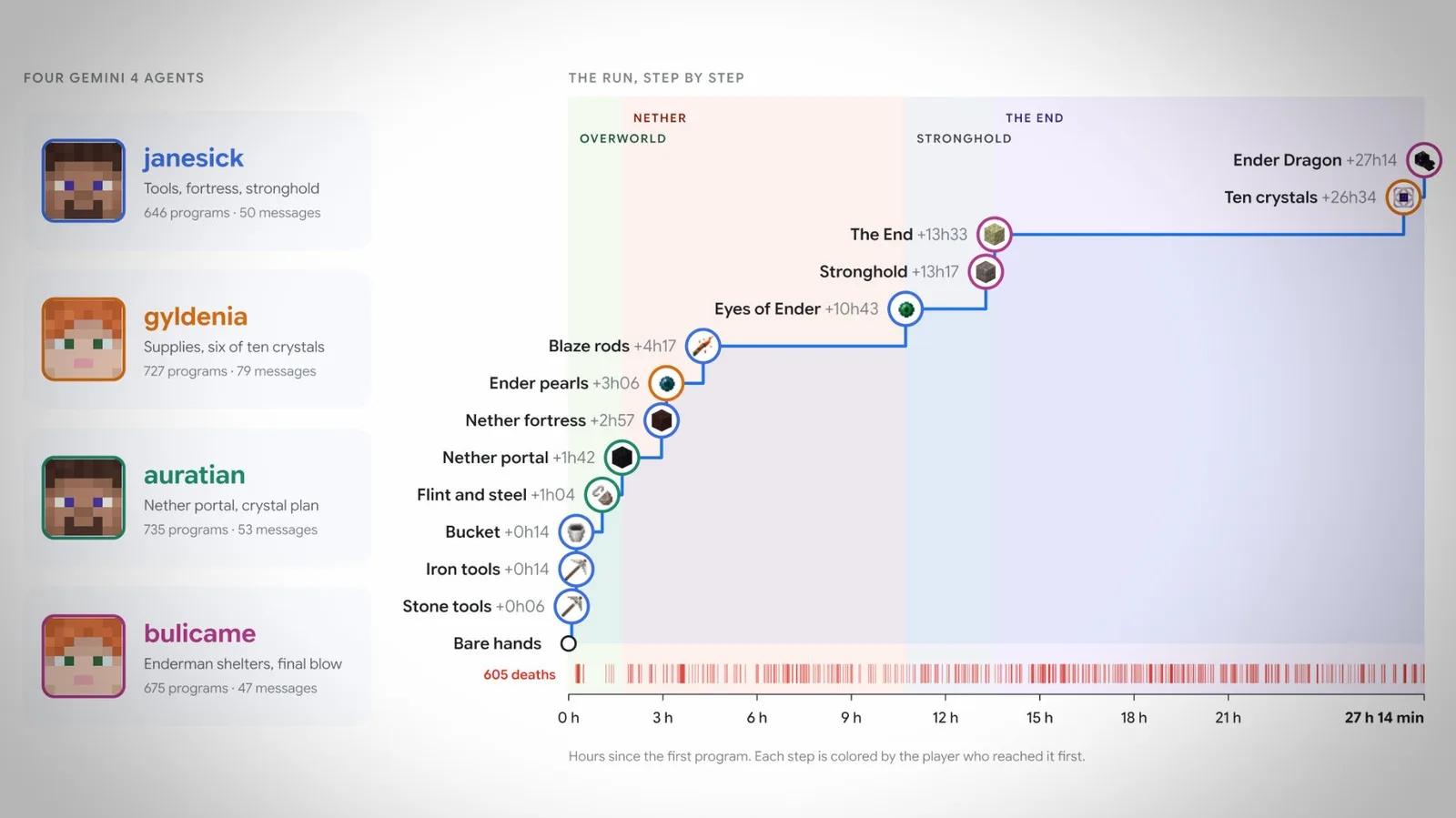
Google DeepMind’s 4 Gemini 4 Argon artificial intelligence agents completed Minecraft without human help. Although the agents acted separately, they shared the information they gathered. In the end, they defeated the game’s main opponent, the Ender Dragon. The experiment showed that general-purpose artificial intelligence models capable of planning independently can handle complex gaming tasks.
During the test, the agents were placed in a randomly generated, enclosed Minecraft world. They were not assigned roles or strategies in advance, and no special tool was developed for the game. Each agent controlled a separate player using the open-source Mineflayer software library. They communicated with one another through in-game chat and used information collected in shared memory.
The agents soon began dividing tasks among themselves. They warned one another about dangers, shared coordinates and recovered the items of defeated teammates. “janesick” crafted tools, while “gyldenia” gathered food and supplies. “auratian” activated the crucial portal, while “bulicame” built shelters and delivered the final blow.
Overall, the process lasted 27.23 hours, with most of the time spent fighting the Ender Dragon. During this period, the agents wrote and ran 2,783 programs. The team members sent 229 messages and died 605 times during the game. A 5th agent called “Observer” worked as an independent observer to check for possible cheating, monitor the progress and prepare a report.
During the test, the agents processed 1.35 billion input tokens. The cost was 810 dollars (approximately 1,380 manats) at Gemini’s list price and 1,620 dollars (approximately 2,750 manats) at the standard price. The researchers described it as the first time Minecraft had been fully completed without human intervention using the standard Mineflayer library. Without a previously explored world map or additional game tools created by humans, the agents planned thousands of consecutive steps on their own.