
11:55Machine-translated from Azerbaijani by AIRead in Azerbaijani
DeepSeek Updates Its Cost-Efficient AI Model, but It Is Prone to Making Up Information

DeepSeek has updated its open-weight “DeepSeek V4.1 Flash” model to version 1017. The new release requires less hardware and operates at a lower cost. In addition to text, the model also accepts images. According to the company, it can be used for open-ended tasks such as writing software based on a general description.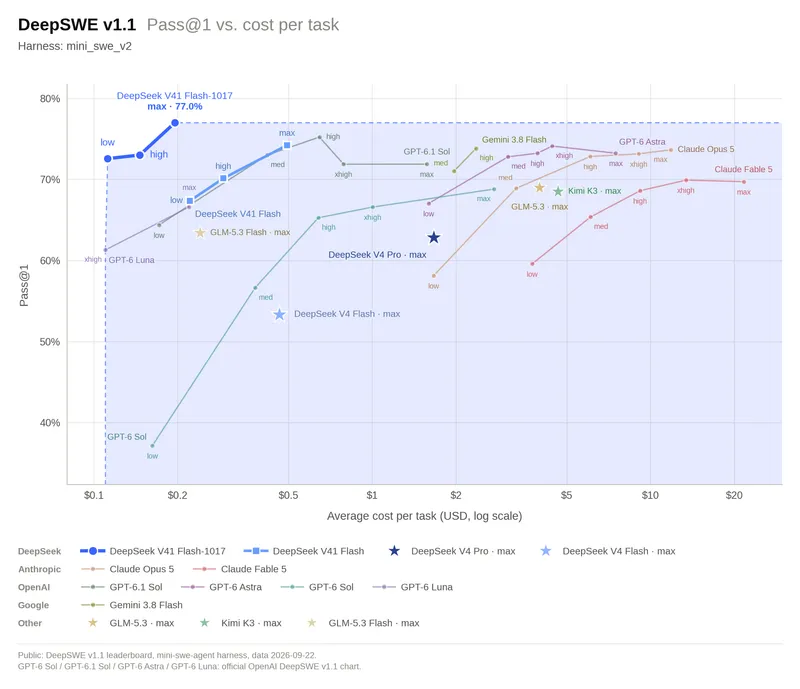 “DeepSeek V4.1 Flash” uses a mixture-of-experts, or MoE, architecture. Put simply, although the model has 552 billion parameters in total, only 16 billion of them are activated for each request. The model has a context window of 1 million tokens. This means it can process large amounts of text at once. In internal tests, the model placed between “GPT-5.6 Sol” and “Claude Opus 5.” The new version requires 4 times less high-speed memory known as HBM and 8 times less SSD space than the previous model. The amount of temporary data stored during operation is just 890 bytes per token. During off-peak hours, 1 million input tokens cost $0.15 (approximately AZN 0.26), while output tokens cost $0.6 (approximately AZN 1.02). When cached data is used, the input price falls to $0.003 (approximately AZN 0.005). DeepSeek charges $0.75 (approximately AZN 1.28) for every 1,000 search queries. For comparison, the same figure for the “Parallel” service is $1 (approximately AZN 1.70). The model scored 45 points in the “Artificial Analysis” evaluation, ranking second among large open-weight models. “Claude Opus 5.5” scored 58 points on the same list. Only “Xiaomi MiMo V2.6-Pro” performed better in terms of task costs. The model’s main drawback is its tendency to fabricate information. In the “Omniscience” test, “DeepSeek V4.1 Flash” answered 43 percent of the questions correctly. However, it provided unsubstantiated information in 67 percent of the cases in which it should not have answered. On an index that awards points for correct answers and deducts points for errors, the model scored just 5 points. “Kimi K3” scored 20 points, while leading closed models scored more than 42 points. The model is therefore better suited to tasks with verifiable results, such as programming, recognizing text in images (OCR), and converting formats. For such tasks, the result can be checked automatically and the task can be performed again if an error occurs. Its results may be unreliable for open-ended research, fact-finding, and preparing precise documents. Although its cost is low, important information should be checked by a person.