
14:16Machine-translated from Russian by AIRead in Azerbaijani
Future of Telecommunications Infrastructure in the AI Era Discussed in Astana
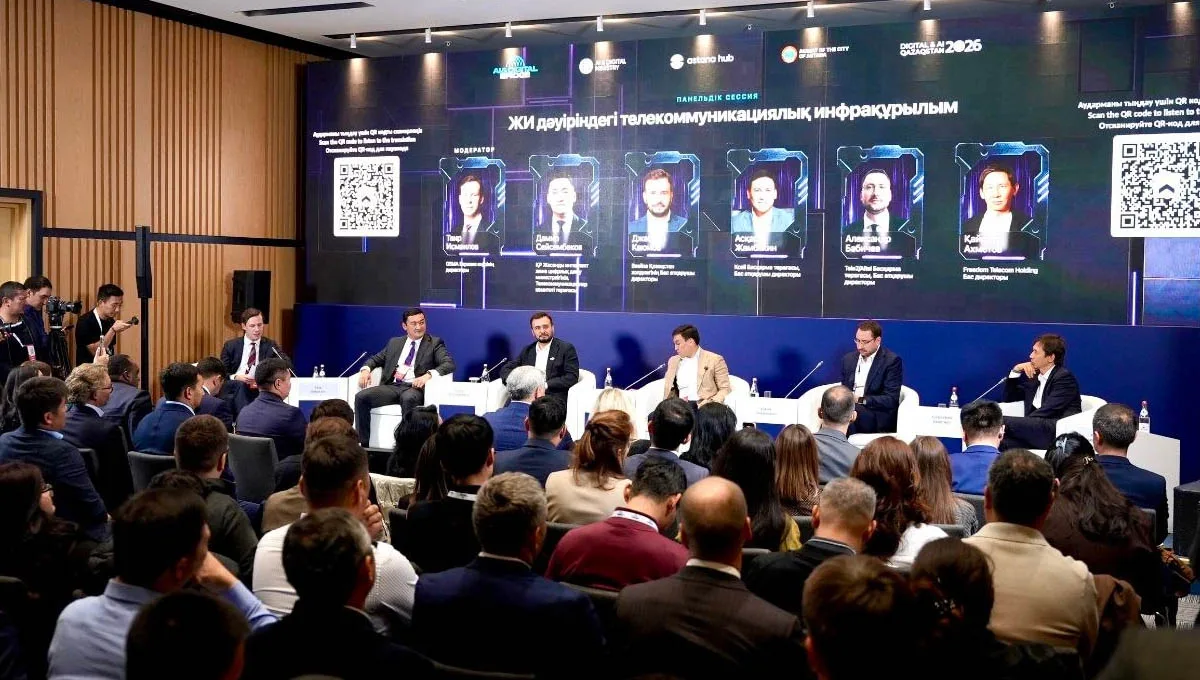
As part of the international AI & Digital Bridge 2026 forum, a panel session titled “Telecommunications Infrastructure in the AI Era” was held, organized by the Telecommunications Committee of the Ministry of Artificial Intelligence and Digital Development of the Republic of Kazakhstan.
The meeting brought together executives from Kazakhstan’s largest telecommunications operators, international experts and government representatives to discuss key challenges and prospects for transforming communications networks amid the active adoption of artificial intelligence technologies.
Participants in the panel discussion included Damir Seyembekov, Chairman of the Telecommunications Committee of the Ministry of Artificial Intelligence and Digital Development of the Republic of Kazakhstan; Tair Ismailov, GSMA Eurasia Regional Director (moderator); Askar Zhambakin, Chairman of the Management Board of Kcell; Jabbor Kayumov, CEO of Beeline Kazakhstan Holding; Alexander Babichev, Chairman of the Management Board of Tele2/Altel; and Kairat Akhmetov, CEO of Freedom Telecom Holding.
The main topic of the discussion was the fundamental shift in requirements for digital infrastructure. As the volume of processed data and the complexity of AI models grow, not only data transmission speed but also minimal latency, high reliability and end-to-end integration of computing are becoming critically important. During the session, the speakers examined in detail the development of 5G networks and prospective 6G standards, the expansion of fiber-optic infrastructure, the implementation of edge computing and the use of AI for intelligent network management.
In his remarks, Damir Seisembekov, Chairman of the Telecommunications Committee of the Ministry of Artificial Intelligence and Digital Development of the Republic of Kazakhstan, emphasized that Kazakhstan has already established a legislative framework for the use of AI, including the classification of systems by risk level and rules for working with the national AI platform.
“The development of the AI economy requires a change in the very role of telecommunications infrastructure. Today, we are witnessing a transition from traditional ‘networks for people’ to flexible AI-native infrastructure connecting users, autonomous systems, data centers and distributed computing capacity. Given the geography of our country, Kazakhstan is developing a hybrid model combining optical channels, 5G networks, edge computing and satellite communications. The competitiveness of the state will be determined by how effectively all this infrastructure is integrated into a single digital environment,” noted Telecommunications Committee Chairman Damir Seisembekov.
During the panel session, the parties also discussed Kazakhstan’s strategic role as a key telecommunications hub between Europe and Asia, ensuring the free and secure cross-border transmission of data, as well as mechanisms for government support of domestic developers, including priority procurement of AI solutions and measures to stimulate the domestic market.
At the conclusion of the session, the parties confirmed their intention to continue working together to build a resilient data center ecosystem and develop the country’s digital connectivity, strengthening Kazakhstan’s position as a technological leader in the region.