
13:02Machine-translated from Russian by AIRead in Azerbaijani
Google Releases Open EmbeddingGemma 2 Model for Local Multimodal Search on Smartphones and AI Agents
Google has unveiled EmbeddingGemma 2, an open and fast multimodal model for local search across text, code, images, and audio directly on users’ devices. It can match files based on the meaning of their content rather than keywords or names. All data is processed without being sent to the cloud, ensuring complete privacy.
The next-generation model is based on the Gemma 4 architecture and is distributed under the commercial Apache 2.0 license. Its key feature is a modular design and high energy efficiency, with a maximum size of 740 million parameters. Developers can use only the components they need: the text module requires just 270 million parameters, the image encoder requires another 170 million, and the audio module requires another 300 million. Matryoshka Representation Learning technology makes it possible to dynamically compress numerical vectors, reducing the amount of memory occupied by databases by up to 6 times.
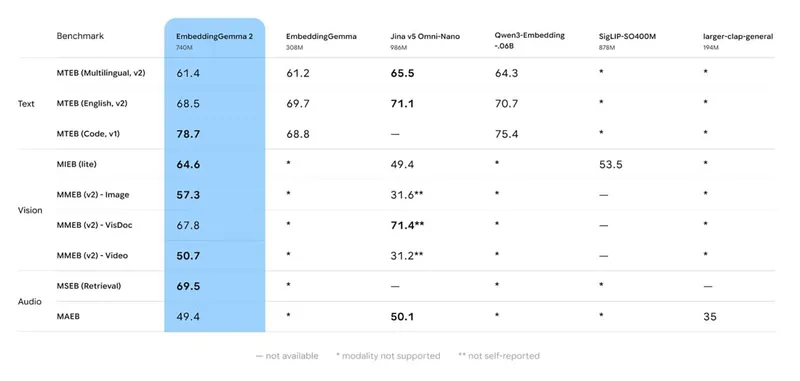
In the specialized MTEB and MAEB benchmarks, EmbeddingGemma 2 delivered the best results among models with up to 1 billion parameters, successfully competing with much larger systems. In the MTEB Code retrieval benchmark, the new model raised the bar from 68.76 to 78.68 points, making it an excellent solution for AI developer assistants. The model also runs easily on smartphones. For example, in tests on the Pixel 11 Pro using quantization, text mode required just 191 MB of RAM, while multimodal mode required about 567 MB.
By sharing a tokenizer and audio encoder with the larger Gemma 4, EmbeddingGemma 2 enables fast and efficient RAG systems to be deployed on devices. The model can be easily integrated using standard tools such as transformers, llama.cpp, Ollama, and LM Studio.
The weights can be downloaded from Hugging Face and Kaggle, and they will soon be available on the Gemini Enterprise Agent Platform.