
15:39Machine-translated from Azerbaijani by AIRead in Azerbaijani
Google’s New EmbeddingGemma 2 Model Enables Smart Offline Search on Smartphones
Google has unveiled its next-generation open model, EmbeddingGemma 2. The model analyzes text, software code, images, and audio files directly on the user’s device, enabling searches based on content and meaning rather than keywords. Most importantly, data is processed locally without being sent to the cloud.
This approach differs considerably from conventional file search. For example, even if users do not remember a specific phrase or file name on their smartphones, they can find relevant documents, images, and other files by describing the information they are looking for. Moreover, privacy is preserved because personal data is not transmitted to servers.
EmbeddingGemma 2 is based on the Gemma 4 architecture and is openly available under the Apache 2.0 commercial license. One of the model’s main advantages is its modular design. Its maximum size is only 740 million parameters, but not all modules have to be used simultaneously. For example, text alone requires 270 million parameters, image processing requires an additional 170 million, and audio requires 300 million parameters.
Google has also used Matryoshka Representation Learning technology in the model. This technology makes it possible to compress numerical representations of data as needed and helps reduce the storage occupied by search databases by up to 6 times.
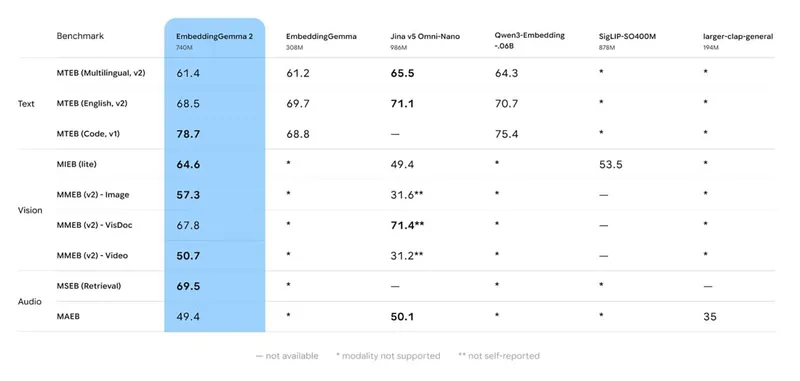
EmbeddingGemma 2 is also ambitious in terms of performance. In the MTEB and MAEB benchmarks, the model achieved one of the highest scores among systems with fewer than 1 billion parameters. Particularly significant progress was recorded in software code search: its score on the MTEB Code benchmark rose from 68.76 to 78.68 points. This makes the model particularly attractive for use in AI assistants created for programmers.
Another advantage of the model is its ability to run on smartphones. For example, during tests of the quantized version on the Pixel 11 Pro, text-only mode required just 191 MB of RAM, while multimodal mode, including text, images, and audio, required approximately 567 MB of RAM. This means that such a system does not need to be constantly connected to powerful cloud servers to operate.
EmbeddingGemma 2’s use of the same tokenizer and audio encoder as Gemma 4 also makes it suitable for creating fast and efficient on-device RAG systems. The model can be integrated with popular tools such as transformers, llama.cpp, Ollama, and LM Studio.
The model weights are already available on the Hugging Face and Kaggle platforms. EmbeddingGemma 2 is also expected to become available through the Gemini Enterprise Agent Platform soon.