
10:29Machine-translated from Azerbaijani by AIRead in Azerbaijani
Japan to Send Spacecraft to Autonomously Land on Mars’s Moon Phobos and Collect Rocks
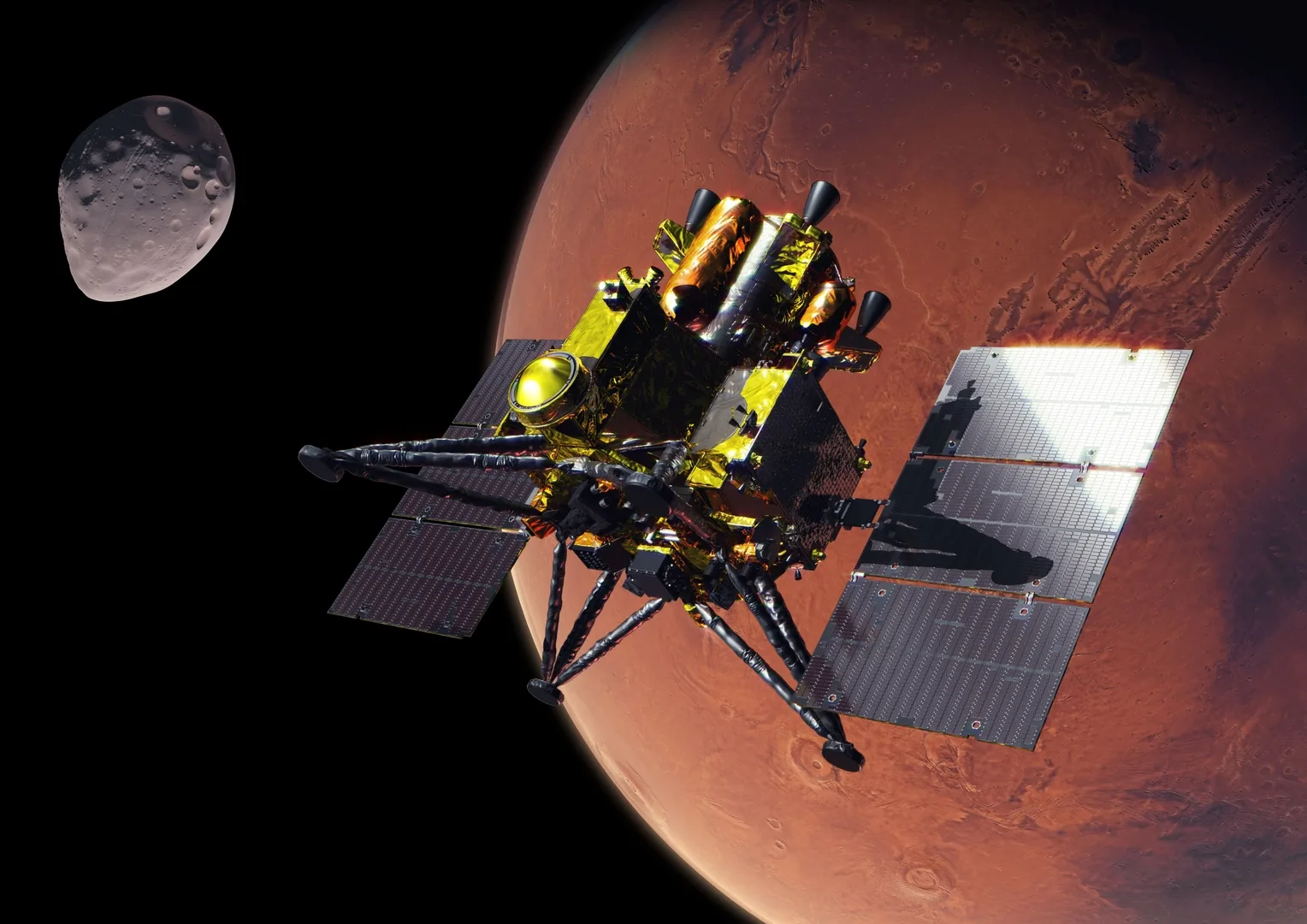
The Japan Aerospace Exploration Agency, JAXA, will launch the MMX mission on October 20, 2026, to retrieve samples from Mars’s moon Phobos. The spacecraft will be launched from the Tanegashima Space Center. The mission aims to collect at least 10 g of material from the surface of Phobos. If successful, rocks collected from a Martian moon will be brought to Earth for the first time. It will take the MMX spacecraft about 1 year to reach Mars. The mission will then operate in the planet’s orbit for 3 years and collect samples from Phobos. The return to Earth will take another 1 year. Scientists therefore expect the rocks to reach Earth in 2031. Studying the samples could help determine the origins of Phobos and Deimos. Scientists will try to establish whether the moons formed from material thrown into space by a massive collision or are asteroids captured by Mars’s gravity. The samples will also be compared with materials previously collected from the surface of Mars. The spacecraft, built by Mitsubishi Electric, will weigh 4,480 kg at launch. More than half of this mass will consist of 3 fuel supplies intended for the cruise, exploration and return phases. The cruise module will separate when the spacecraft reaches Mars. The exploration module will be released after the spacecraft passes Deimos. Landing on Phobos, which has a radius of about 11 km, is not easy. The moon’s gravity is about 300 times weaker than the Moon’s but 50 times stronger than that of the asteroid Ryugu. As a result, keeping the spacecraft hovering above the surface for a long time would consume a great deal of fuel. It can take up to 20 minutes for a radio signal to travel between Earth and the spacecraft. MMX will therefore make its own decisions concerning landing and takeoff. It will use a high-precision autonomous navigation system to do so. During the landing, the system will compare a map of Phobos’s craters with real images to correct the spacecraft’s position. When its altitude drops below 300 meters, hazardous irregularities on the surface will be identified. If necessary, the spacecraft will select another landing site or abort the landing and ascend again. Before the main spacecraft lands, the small IDEFIX research vehicle developed by the French and German space agencies will be released onto Phobos. IDEFIX will conduct independent research for about 100 days and survey the area to enable a safer landing. After the main spacecraft lands, its robotic arm will insert cylindrical tubes into the surface to collect samples. Another device developed by NASA will use a stream of nitrogen to collect fine dust particles from the surface layer. Scientists expect about 0.1 percent of the material to consist of debris knocked off Mars and deposited on Phobos by meteorite impacts. The MMX mission costs about $345 million (about 586.5 million manats). It will be the first research spacecraft Japan has sent to Mars in the past 28 years. In addition to clarifying the origins of Phobos and Deimos, the mission will allow new technologies for returning samples from Mars and conducting return flights to be tested. Safely delivering the collected material to Earth is considered an important technical test for future Mars missions.