
11:42Machine-translated from Azerbaijani by AIRead in Azerbaijani
Microsoft Unveils Maia 300 AI Chip, Production to Begin in 2027
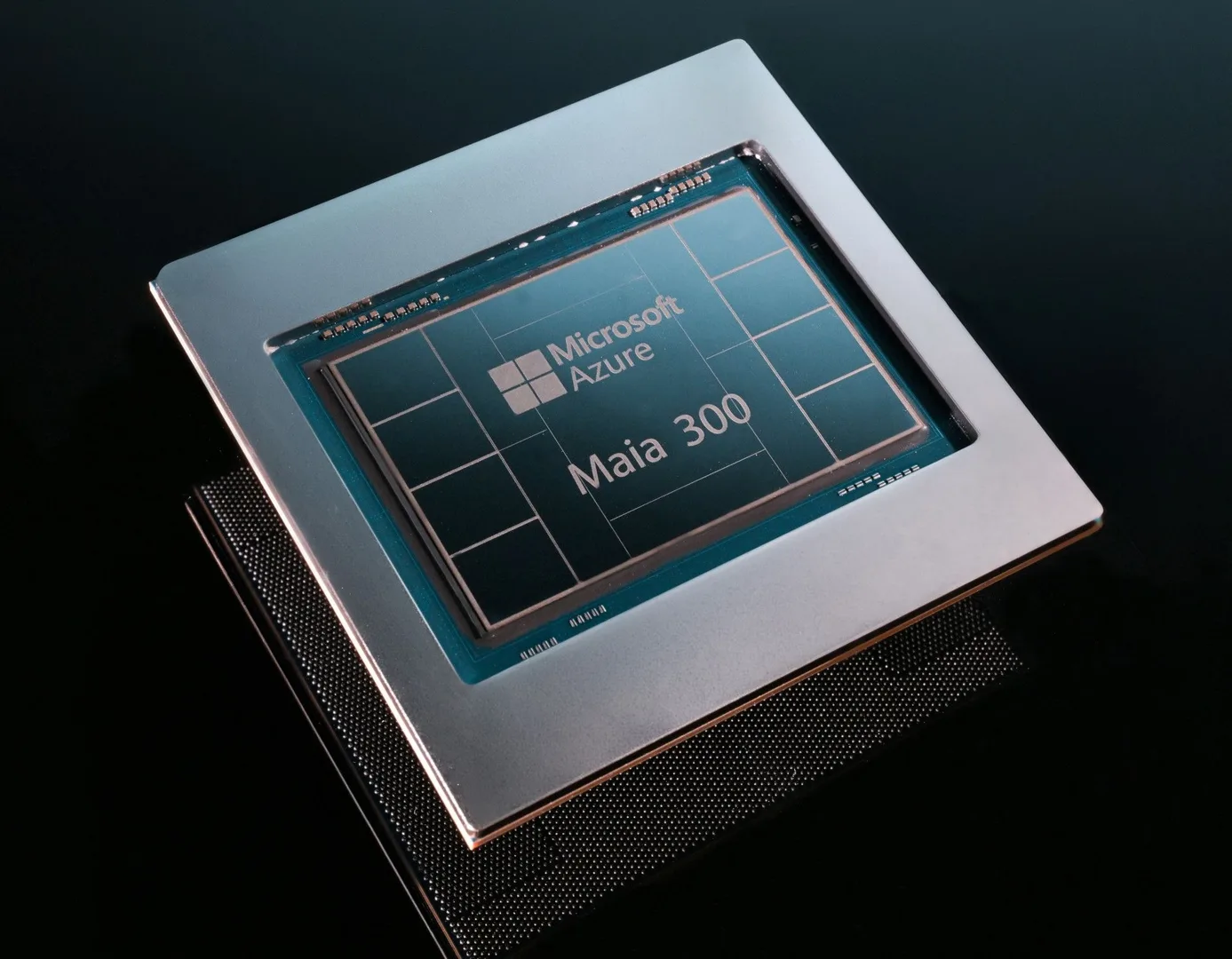
Microsoft plans to make the Maia 300 accelerator the foundation of artificial intelligence (AI) computing across its products and services. Production of the chip and deployment of systems with several gigawatts of capacity will begin in 2027. The system will primarily operate during the inference stage, when an AI model generates a response to a user’s query. This will allow the company to make broader use of its own chips. The Maia 300 is 36% more powerful than the previous Maia 200. Data transfer with memory is also 2.5 times faster. When generating long responses and running AI agents, the chip often has to wait for data to arrive from memory. The new architecture is designed to reduce this delay. For this reason, Microsoft has focused more on memory speed than on raw computing power. Instead of a single large chip, the Maia 300 contains several smaller chiplets combined in the same package. The computing components will be manufactured using TSMC’s N2P process. The components that manage memory and handle data input and output will be positioned separately. The system has 8 HBM4 memory stacks. Together, they provide 288 GB of memory and a speed of 18 TB/s. For comparison, the Maia 200 has 216 GB of memory. Its memory speed is 7.1 TB/s. Microsoft announced in July that operating the Maia 200 system for OpenAI and its own models costs 40% less than using Nvidia’s latest chips. However, the company did not say which GPU model was used for the comparison. The Maia 300 has not yet undergone independent testing either. Analysts expect the Maia line to account for just 10% of the company’s total spending on AI chips in the first quarter of 2027. In the quarter that ended in July, Nvidia’s revenue was $96.2 billion (approximately 163.5 billion manats). Of this, $89 billion (approximately 151.3 billion manats) came from its data center division. The company’s gross margin, a key measure of profitability, reached 75%. Major cloud operators generated $49 billion (approximately 83.3 billion manats) in revenue for Nvidia. Microsoft will continue using Nvidia and AMD chips to train models. Google and Amazon are also increasing their use of their own AI chips. At the same time, both companies continue to buy Nvidia products. Gartner forecasts a sharp increase in AI infrastructure spending in 2026. Spending is expected to approach $1 trillion (approximately 1.7 trillion manats). This investment is not expected to be fully recouped through revenue until at least the end of 2032. Therefore, the Maia 300 will not replace Nvidia anytime soon. The chip is primarily intended to reduce Microsoft’s costs and dependence on external suppliers.