
15:02Machine-translated from Russian by AIRead in Azerbaijani
Money That Isn’t There: How Fake Crypto Payment Scams Work
Your wallet shows “USDT” with the correct logo and the expected dollar amount. You hand over the item—only to discover that you were paid with worthless tokens. We explain how one of the most insidious crypto scams works and how to avoid falling for it.
Imagine you are selling something online—a gaming account, skins, a freelance service, or a physical item. The buyer offers to pay in cryptocurrency. A minute later, a well-known coin appears in your wallet: the familiar name, the recognizable logo, and the correct dollar amount. Reassured, you hand over the item.
Later, you try to exchange what you received—and discover that there is nothing to exchange. The token is worthless.
This is a fake payment scam. The trick is that the transfer technically did arrive—it is simply not the coin it claims to be.
How the scam works
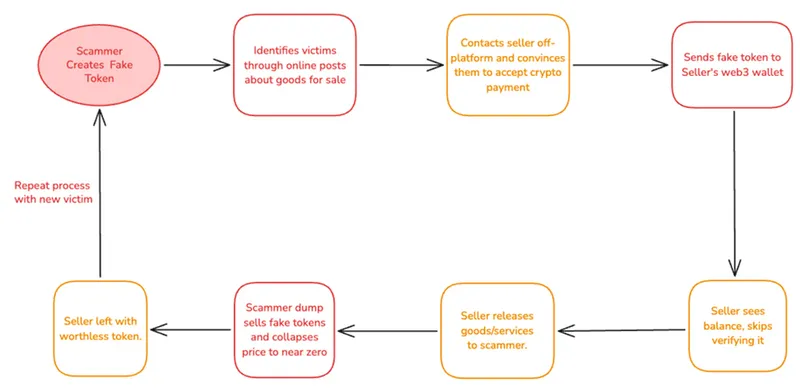
On a blockchain, anyone can issue their own token and call it anything they want—USDT, BTC, or BNB—and even give it the official logo. Scammers take advantage of this. They usually launch the fake token through a meme-token launchpad, which is quick and almost free.
Everything else depends on liquidity. The scammer keeps almost the entire token supply and creates a tiny liquidity pool—containing roughly $2,000–5,000 in real USDT or BTC—to give the appearance of a “market price.” Because of this pool, the wallet displays a dollar price for the token, and the victim sees the “correct” amount.
As soon as the item or service has been handed over, the scammer dumps their entire supply into the pool. With so little liquidity, this sale drains almost all the real money from it. The pool is left with a mountain of useless tokens and virtually none of the real asset—the price collapses to zero. The seller is left holding coins that cannot be sold to anyone.
Who scammers target
Scammers do not cast their net at random. They monitor both blockchain activity and ordinary listings—on social media, messaging apps, and online marketplaces. Anyone selling something is a potential target: gaming items and in-game currency, freelance services, or physical goods. Another variation involves fake tokens disguised as “investment returns.”
The main targets are crypto newcomers. The scammer first cautiously gauges how much the other person knows about the subject and offers to pay in cryptocurrency only after becoming confident that the payment will not be verified. Then the scammer starts applying pressure: “Come on, hurry up, I need it urgently.”
A real case: The “BNB” that did not exist
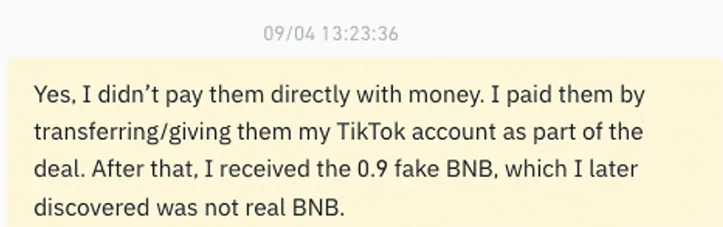
One user sold their TikTok account for 0.9 BNB. The money arrived, and the account was transferred to the buyer. The problem was discovered only when the seller tried to withdraw the funds: the “BNB” in the wallet turned out to be an imitation—a counterfeit token that could neither be exchanged nor withdrawn.
How to protect yourself: Agree on the details first, then verify
Protection begins before payment. Before agreeing to accept cryptocurrency, clearly establish with the buyer exactly what you are supposed to receive:
- which network the payment will arrive on (Ethereum, BNB Smart Chain, or another);
- the token’s official contract address, if applicable;
- the coin’s name and ticker;
- the exact amount.
When the payment arrives, check it against these details. Before handing over anything valuable, go through this short checklist.
A five-point checklist
- Network. A token with the same name can exist on different blockchains. Make sure the money arrived on the exact network you agreed upon.
- Full contract address. A name, ticker, and logo are extremely easy to fake—do not trust them. Compare the contract address with the official address from a reliable source: the issuer’s website or a listing on a major exchange. Compare the entire address, not just its first and last characters.
- Actual value and ability to withdraw. The dollar amount shown by the wallet can be misleading. If you plan to withdraw the funds as fiat currency, make sure the token can actually be exchanged at the expected price. A fake token may appear tradable at one moment—and become impossible to sell a minute later.
- Pressure and urgency. Red flags include being rushed to hand over the item, being asked to trust someone’s word or a screenshot instead of verifying the payment, and being told to ignore wallet warnings. If something seems strange, stop and check. An honest buyer will not object to basic payment verification.
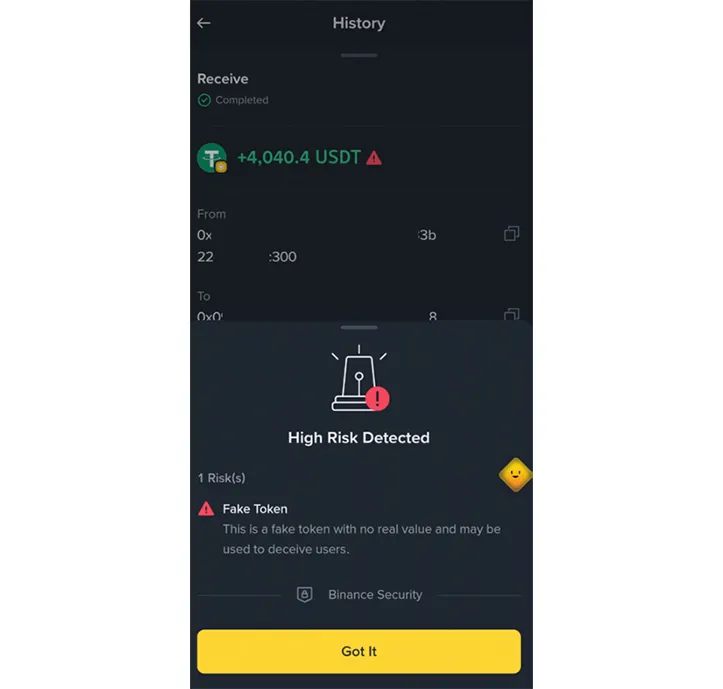
- Wallet warnings. Wallets can flag suspicious tokens when data is available. If you see such a warning, it is a serious cause for concern: the token is most likely fake. But remember that this protection is not foolproof: the absence of a warning does not guarantee that everything is legitimate.
You received a suspicious token—what should you do?
If you have doubts about a coin you received:
- do not hand over the item or provide the service until you have figured it out;
- do not give the token permission (approve) to spend funds—this could provide access to your wallet;
- save the token’s contract address and the transaction hash;
- contact your wallet’s support team, but only through an official channel;
- do not send the token to other people, as this would expose them to the same scam.
The key takeaway
The scam works only because the fake token is visually indistinguishable from the original. That also makes the protection simple: look at the data, not the image—the network and the contract address. Verify the payment before handing over anything valuable. Wallet warnings are a useful safeguard, but your own verification is the primary filter.
If you are interested in the subject, it is also worth reading about related scams: honeypot tokens, which can be bought but not sold, and rug pulls, in which a project’s creators suddenly withdraw all the liquidity.
This article was prepared using material from the Binance blog post “Fake Payment Scams Explained: How They Work and How to Stay Safe,” dated September 24, 2026. Illustrations by Binance. This material is for informational purposes only and does not constitute financial advice.