
17:12Machine-translated from Azerbaijani by AIRead in Azerbaijani
Nvidia Unveils RTX Spark Platform for Local AI
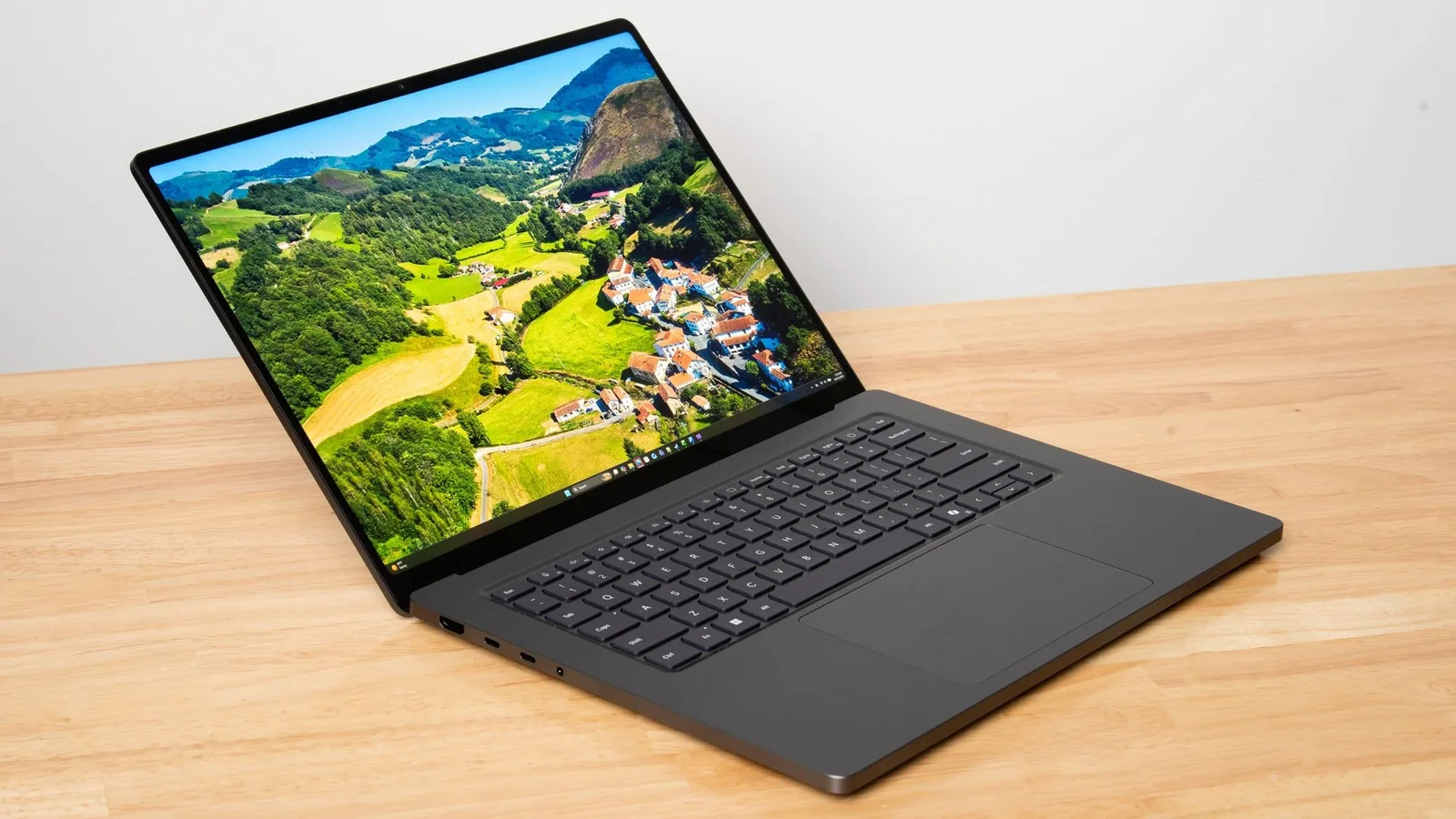
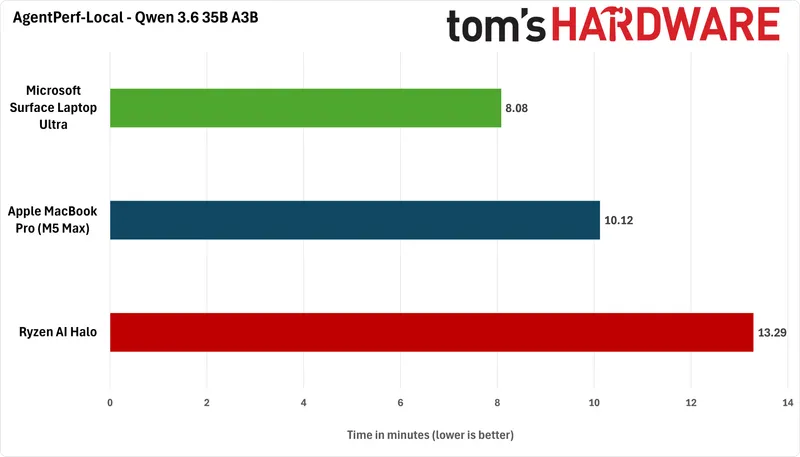
Nvidia CEO Jensen Huang unveiled the RTX Spark platform at Computex 2026. The platform, which aims to reshape computers, combines the GB10 Superchip with an Arm-based Windows system. The system is designed to run AI agents securely and directly on the computer without sending data to another server. Microsoft, Dell, HP, MSI, Lenovo and Asus are developing laptops for the platform. One of the first tests was conducted on the Microsoft Surface Laptop Ultra.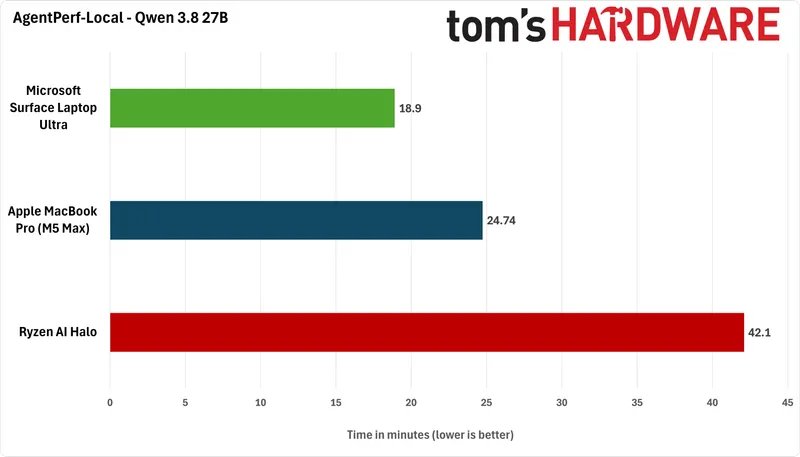 The most powerful Surface Laptop Ultra configuration tested has 20 CPU cores and 6,144 CUDA cores. The laptop is equipped with 128 GB of LPDDR5X 9400 RAM. The device was compared with an M5 Max MacBook Pro with 128 GB of memory. A Ryzen AI Halo with a Ryzen AI Max+ 395 processor also took part in the test. In the Geekbench test, RTX Spark’s processor performance lagged far behind the M5 Max. Nevertheless, no significant slowdown was recorded in everyday use. The speed at which AI models run directly on the computer was tested with AgentPerf Local. This test measures how long an AI agent takes to complete a task. RTX Spark delivered the best result with the smarter but more demanding Qwen 3.8 27B model. The M5 Max MacBook Pro took approximately 25 percent longer to complete the same task. Ryzen AI Halo completed the test in 40 minutes. This result was approximately 2 times worse than those of the other 2 systems. With the lighter Qwen 3.6 35B A3B model, the Surface Laptop Ultra completed the task in 8 minutes. The MacBook Pro did it in 10 minutes, while Ryzen AI Halo took 13 minutes. The tests were conducted using llama.cpp. The corresponding CUDA, Metal and ROCm acceleration was used on each platform. According to the results, RTX Spark outperformed its rivals with both demanding and faster-running local AI models.
 The results were not equally strong in games. Gears of War E-Day was run at a resolution of 1908x1272. The game averaged 77.7 FPS, with latency of 83.5 milliseconds. Control Resonant was tested at a resolution of 2560x1440 with ray tracing disabled. In MFG 3X mode, the result was 109.2 FPS. However, latency of 78.3 milliseconds was recorded. The need for DLSS technologies to maintain the frame rate also limited the gaming experience. One of the main issues in games is that the shared memory’s data transfer speed remains at 300 GB/s. The processor’s performance and the Prism emulator, which runs x86 games, also affect performance. For those seeking high speeds and ray tracing, a gaming laptop with a dedicated RTX 50 graphics card is a more suitable choice. The secure local AI agents promised for Windows 11 are not yet ready either. Nevertheless, RTX Spark, a first-generation platform, demonstrated high speeds in local AI tasks but remains a very expensive solution.
The most powerful Surface Laptop Ultra configuration tested has 20 CPU cores and 6,144 CUDA cores. The laptop is equipped with 128 GB of LPDDR5X 9400 RAM. The device was compared with an M5 Max MacBook Pro with 128 GB of memory. A Ryzen AI Halo with a Ryzen AI Max+ 395 processor also took part in the test. In the Geekbench test, RTX Spark’s processor performance lagged far behind the M5 Max. Nevertheless, no significant slowdown was recorded in everyday use. The speed at which AI models run directly on the computer was tested with AgentPerf Local. This test measures how long an AI agent takes to complete a task. RTX Spark delivered the best result with the smarter but more demanding Qwen 3.8 27B model. The M5 Max MacBook Pro took approximately 25 percent longer to complete the same task. Ryzen AI Halo completed the test in 40 minutes. This result was approximately 2 times worse than those of the other 2 systems. With the lighter Qwen 3.6 35B A3B model, the Surface Laptop Ultra completed the task in 8 minutes. The MacBook Pro did it in 10 minutes, while Ryzen AI Halo took 13 minutes. The tests were conducted using llama.cpp. The corresponding CUDA, Metal and ROCm acceleration was used on each platform. According to the results, RTX Spark outperformed its rivals with both demanding and faster-running local AI models. The results were not equally strong in games. Gears of War E-Day was run at a resolution of 1908x1272. The game averaged 77.7 FPS, with latency of 83.5 milliseconds. Control Resonant was tested at a resolution of 2560x1440 with ray tracing disabled. In MFG 3X mode, the result was 109.2 FPS. However, latency of 78.3 milliseconds was recorded. The need for DLSS technologies to maintain the frame rate also limited the gaming experience. One of the main issues in games is that the shared memory’s data transfer speed remains at 300 GB/s. The processor’s performance and the Prism emulator, which runs x86 games, also affect performance. For those seeking high speeds and ray tracing, a gaming laptop with a dedicated RTX 50 graphics card is a more suitable choice. The secure local AI agents promised for Windows 11 are not yet ready either. Nevertheless, RTX Spark, a first-generation platform, demonstrated high speeds in local AI tasks but remains a very expensive solution.