
14:57Machine-translated from Russian by AIRead in Azerbaijani
OpenAI to Start Watermarking Text Generated by ChatGPT and Codex
OpenAI has announced that it will soon roll out an important update to its popular ChatGPT and Codex models. In the coming weeks, text generated by the services will begin receiving a special invisible marker that makes it possible to conclusively identify its artificial origin. The move is driven by the strict provisions of the EU AI Act, which requires the output of generative models to remain easily recognizable in order to protect the information environment. To implement this rule, the developers will use a proprietary technology called textGrain.
What makes this method unique is that it does not distort how people perceive the material in any way. The system does not insert hidden characters, invisible spaces, or nonstandard punctuation marks into the final responses. Instead, during generation, the algorithm imperceptibly adjusts the mathematical probability of selecting subsequent words and their parts. As a result, a subtle statistical pattern is formed in the structure of the text. An ordinary user will not notice it, but a specialized detector will identify it with ease.
The new protection is not an absolute solution and is far from effective in every situation. The effectiveness of the analysis depends directly on the length and style of the content provided. For example, concise responses are much harder to recognize, while the detector’s accuracy declines noticeably when analyzing highly specialized or strictly formalized material, such as mathematical texts. Internal tests showed that, with a minimum false-positive rate of 1%, the system consistently detects the hidden watermark in 80% of texts about 200 tokens long and achieves 95% effectiveness on material at least 400 tokens long.
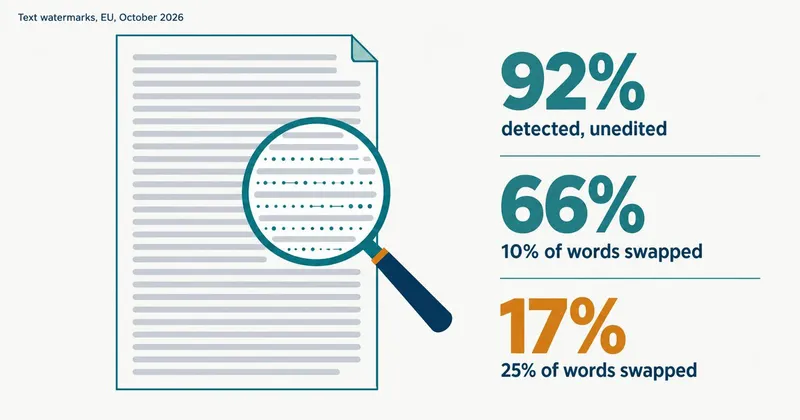
The main vulnerability of the proposed method remains subsequent human editing of the finished material. Experiments with 400-token texts clearly demonstrated that even superficial editing can bypass the protection. Simply replacing just 10% of the words with synonyms that have similar meanings reduces the probability of detecting the machine-generated trace from the initial 92% to 66%. If a user paraphrases at least a quarter of the original text, scanning effectiveness falls to a critical 17%, making the marker practically useless.
At the project’s launch, access to the verification tools will be limited to accredited research centers and specialized organizations. In the long term, however, there are plans to make textGrain technology available to third-party developers. Meanwhile, customers worldwide using solutions through the API will be able to manually enable this feature for supported models, as it will remain disabled by default in the application programming interface.