
18:19Machine-translated from Azerbaijani by AIRead in Azerbaijani
Potential AMD Steam Deck Chip Surfaces With 6 Cores and 24 GB of Memory

A new AMD engineering sample has surfaced in tests in the OpenBenchmarking database. The chip has a 6-core, 12-thread processor and is equipped with 24 GB of high-speed LPDDR5 memory. The sample is believed to belong to the Zen 6-based Gainsborough family and to be intended for a future Steam Deck handheld gaming console. However, AMD and Valve have not confirmed this.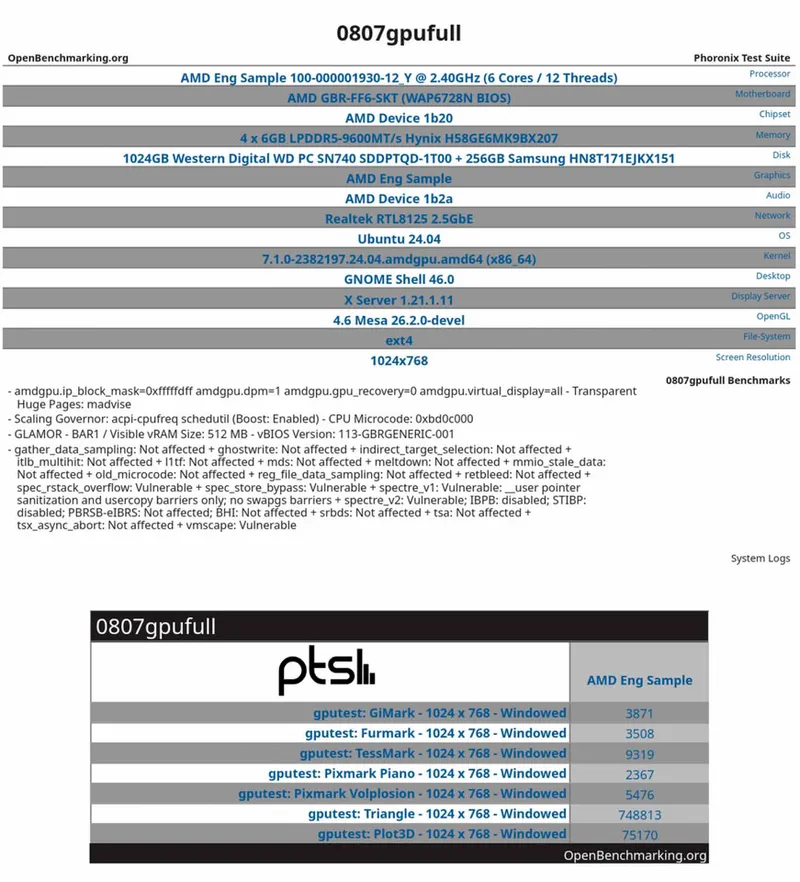 The processor ran at 2.4 GHz in the test. The memory consisted of 4 SK Hynix modules, each with 6 GB. Its speed reached 9,600 MT/s. For comparison, the current Steam Deck model has 16 GB of LPDDR5 memory running at 6,400 MT/s. The console’s AMD Zen 2 processor has 4 cores and 8 threads. This means the new sample has considerably more cores and memory capacity. The main clue to the processor’s architecture is its internal identification code. The sample, identified as “Family 1Ah, model DCh,” falls within a range reserved for newer Zen 6 processors in Linux. Therefore, the Gainsborough family is believed to be based on AMD’s next-generation architecture. However, it is not known whether this will be standard Zen 6 or Zen 6C, which fits more cores into the same area. The integrated graphics processor’s clock speed was listed as 2,400 MHz. Its architecture and number of compute units were not disclosed. The sample was tested on Ubuntu 24.04. The resolution in GpuTest was 1,024 x 768. The chip scored 3,871 points in the GiMark test and 3,508 points in the FurMark test. Its TessMark result was 9,319 points. Although the FurMark score is close to that of the original Steam Deck model, these figures do not reflect actual gaming performance. The tests were conducted not on a finished device, but with a platform and software that are still under development. The final result will be affected by the power limit, cooling system, driver maturity and final graphics processor configuration. If the specifications remain unchanged, the additional processor cores and faster memory could represent a major upgrade for a future Steam Deck. For now, it has not been confirmed that this chip will be used in a commercially available device.