
23:23Machine-translated from Azerbaijani by AIRead in Azerbaijani
Scientists Develop System That Detects Deepfake Videos Using Light
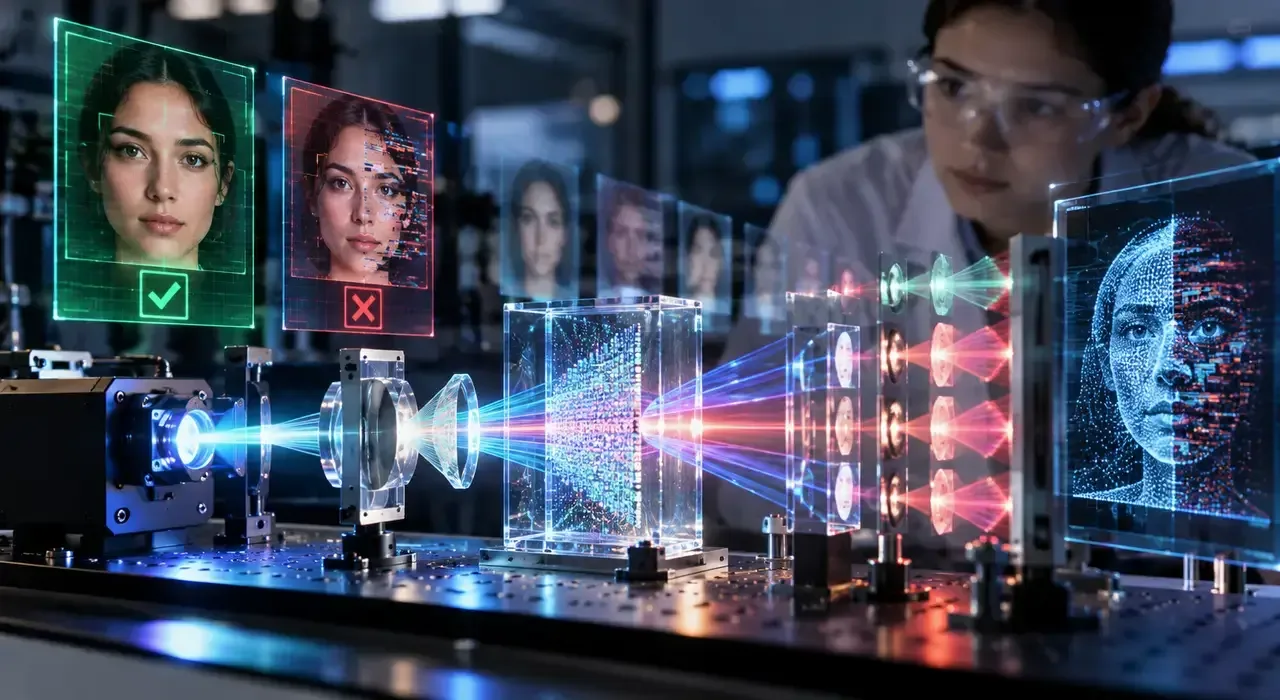
Researchers in the US have developed a new system for detecting deepfake videos that performs some of the computations using light instead of a conventional processor. During experiments, the technology identified fake videos with 97.79% accuracy and analyzed at least 15 videos simultaneously.
The findings on the system, developed by researchers at the University of California, Los Angeles (UCLA), were published in the scientific journal “eLight.”
The technology combines a traditional neural network with an optical decoder. First, the digital part of the system converts the video frames into a more compact form of data. This data is then sent to a programmable spatial light modulator, and some of the computations are performed as the light passes through the optical system.
This approach reduces the need for each video to be processed sequentially by a complex digital neural network. During the experiment, the system was able to analyze 15 video streams in parallel with a single optical pass. The researchers also tested a version that processed 18 videos simultaneously.
In tests conducted on the Celeb-DF dataset, deepfake detection accuracy was 97.79%, sensitivity was 99.86%, and specificity was 95.72%. In other words, the system failed to detect approximately 0.14% of fake videos and classified them as real.
Even when the number of videos processed in parallel was increased to 18, the system’s overall accuracy remained at 96.13%.
Another advantage of the new approach is its energy efficiency. The optical decoder performs certain operations by using the physical propagation and diffraction of light rather than digital computation. This may reduce the computational load compared with fully digital systems. In certain configurations, adding passive optical layers also increased detection accuracy without significantly increasing energy consumption.
However, the technology is currently at the experimental stage. The 97.79% result was achieved on a specific test dataset and does not mean that the system will deliver the same result on every type of deepfake material.
The researchers primarily see the technology as an initial filter for quickly screening large volumes of video streams. The system could rapidly identify suspicious videos, after which those materials could undergo additional, more detailed analysis.