
16:14Machine-translated from Russian by AIRead in Azerbaijani
Global PC Market Plunges 22.4% as Memory Prices Soar
According to a new report from research firm Gartner, the global personal computer market fell sharply in the third quarter, declining 22.4% year over year to 55.4 million units. The main trigger for such a large-scale contraction in the industry was a significant increase in component prices, primarily for RAM and solid-state drives. Gartner analysts emphasize that higher component prices have already been fully reflected in the retail prices of finished devices. In the second quarter alone, DRAM chip prices surged fivefold compared with the same period last year. PC manufacturers were forced to pass these increased costs on to end consumers, which predictably deterred a significant share of potential buyers and led to a collapse in shipments in the following months.
Current computer sales volumes have fallen back to levels seen in early 2023, but the market’s structure and dynamics are now fundamentally different. This time, vendors were not faced with excess inventories of finished products—the decline in demand was caused solely by pricing. Under these conditions, manufacturers shifted their focus toward producing more expensive, higher-margin configurations. In an effort to optimize the use of scarce components, they largely ignored the entry-level price segment, leaving it without a broad selection of products. The corporate sector also contracted: instead of broadly upgrading their device fleets, companies switched to targeted purchases, favoring high-performance workstations and modern solutions with artificial intelligence capabilities.
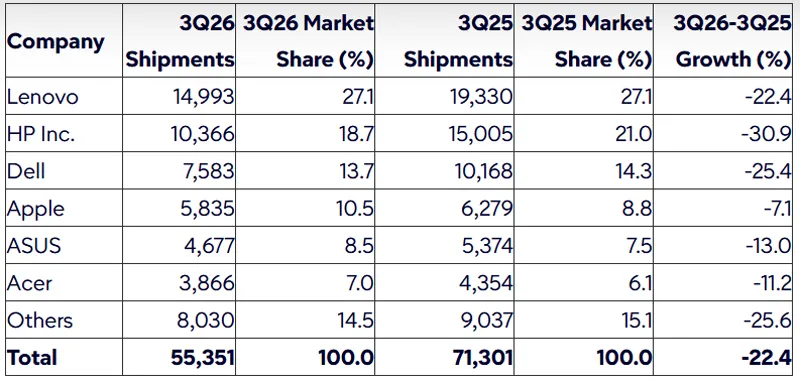
The decline in shipment volumes affected every member of the world’s “big six” PC vendors, although the impact was uneven. Market leader Lenovo reduced shipments by 22.4% to 14.99 million units, while maintaining a stable 27.1% share of the global market. Second-place HP Inc. was hit much harder, with its volume plunging 30.9% to 10.37 million PCs and its market share falling from 21% to 18.7%. A critical factor for HP Inc. was its traditional focus on the mass-market consumer and corporate segments, which were the first to react to inflation. Third-place Dell recorded a 25.4% decline in shipments to 7.58 million units, while its share fell from 14.3% to 13.7%.
Fourth-place Apple weathered the crisis better than the others, posting the smallest decline in shipments—just 7.1% to 5.84 million PCs. Thanks to this resilience, its share of the global market rose from 8.8% to 10.5%. Fifth-place Asus limited its decline in volume to 13%, shipping 4.7 million units and increasing its market share from 7.5% to 8.5%. Sixth-place Acer also improved its market position, raising its share from 6.1% to 7.0% despite an 11.2% decline in shipments to 3.87 million devices. Smaller manufacturers collectively accounted for no more than 14.5% of the market, compared with 15.1% a year earlier, while their combined shipments fell 25.6% to 8.03 million units.
Analysts at research firm IDC offer an alternative view of the situation, with previously published statistics that differ from Gartner’s data. According to IDC, the third-quarter decline was less severe at 20.1%, while total shipments reached 62.7 million units. IDC’s report also identified Apple and Asus as the most resilient companies during the crisis, but Acer did not make its top five and was placed in the “others” category. In addition, IDC experts recorded an unusual sequential decline in shipments of 9.1% compared with the previous quarter, completely contradicting long-standing seasonal trends. The key conceptual difference between the two research firms concerned the industry leader: unlike their IDC counterparts, Gartner’s experts do not believe Lenovo reduced its share of the global PC market compared with the third quarter of last year.