
17:30Machine-translated from Azerbaijani by AIRead in Azerbaijani
Hera Probe Reaches Asteroid Struck in Planetary Defense Test
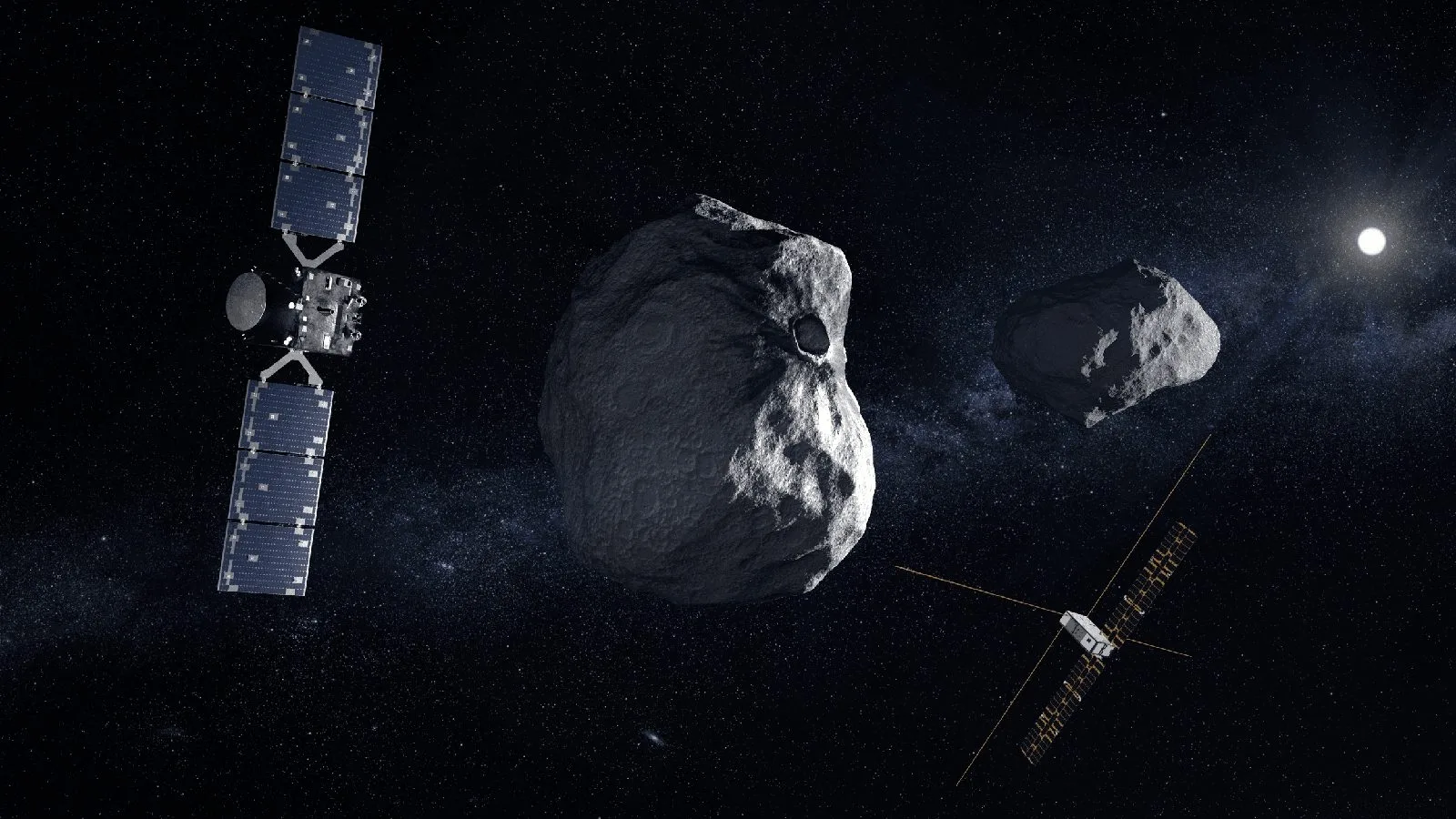
The European Space Agency’s Hera probe has reached the vicinity of the Didymos and Dimorphos asteroids, which were used in a planetary defense test. The mission will closely examine the orbit altered by NASA’s DART probe. The data collected will show how effective it could be to deflect asteroids that pose a threat to Earth in time.
In mid-April 2029, the 450-meter-diameter asteroid Apophis will come within approximately 31,000 kilometers of Earth. This is about 12 times less than the distance to the Moon, and the asteroid will be visible to the naked eye. Slightly changing a dangerous object’s speed is considered safer than breaking it apart. This could cause the asteroid to arrive late at the point where it might have collided with Earth, allowing it to pass by the planet.
The asteroid Didymos has a diameter of 780 meters and completes one rotation on its axis every 2.3 hours. Because it rotates so rapidly, the asteroid is close to the threshold of losing stability. Dimorphos, which has a diameter of 151 meters, orbits it in approximately 12 hours. NASA sent the DART probe to this asteroid pair at the end of 2021. Approximately 1 year later, the probe crashed into Dimorphos at more than 21,000 km/h.
Scientists expected the smaller asteroid’s orbital period to decrease by at least 1 minute after the collision. Instead, its orbit was shortened by 33 minutes. This was caused not only by the impact but also by the additional thrust generated in the opposite direction by material ejected from the surface. After the collision, the speed of both asteroids around the Sun decreased. Dimorphos briefly resembled a comet because a long dust tail formed behind it.
The European Space Agency launched the Hera probe in October 2024. After passing near Mars, the spacecraft began approaching its target in October 2026. The first image was taken from a distance of approximately 1,300 kilometers, while the first detailed image of Didymos was released in early November. This will be the first mission to study a binary asteroid system closely and in detail. The probe will examine the impact site and the structure of the crater and measure the precise mass of Dimorphos.
Hera’s lidar instrument will use a laser to measure distances and create a map of the asteroids’ surfaces. Other instruments will examine the chemical composition of the surface. The cameras will capture images showing details as small as 1 meter. The data collected will help determine whether material strength or gravity had a greater influence on the crater’s formation.
In January 2027, Hera will deploy 2 small CubeSat satellites named Juventas and Milani. Both satellites will attempt to land on the asteroid’s surface. Juventas will examine Dimorphos’s internal structure with radar that can penetrate to a depth of 100 meters and will use a separate instrument to measure changes in gravity. Milani will study the surface composition and search for traces of dust and easily vaporized substances. The main mission is expected to continue until next summer. The number of known near-Earth asteroids was just 300 in 2000. That figure has now exceeded 43,000.