
16:06Machine-translated from Azerbaijani by AIRead in Azerbaijani
Tufa Labs’ AI System Compresses 1 GB of Text Losslessly to 105.39 MB
On November 19, 2026, Tufa Labs announced the results of a new compression experiment called “tufazip.” The system reduced 1 GB of text taken from Wikipedia to 105.39 MB without losing any data. This is the best result in the Large Text Compression Benchmark among solutions that compress text using only a neural network’s predictions. However, “tufazip” is not yet a product ready for everyday use.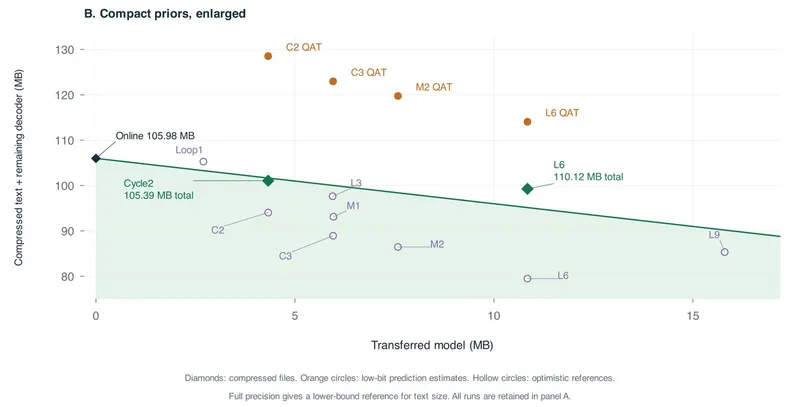 “tufazip” uses a Transformer model with 163 million parameters that predicts how the text will continue. The full model has 12 layers, meaning that each prediction passes through 12 stages. The initial model added to the archive has 34 million parameters and takes up just 4.33 MB. Its 2 pretrained layers are copied in memory to create 12 layers. As the text is processed, each copy learns independently. The system is not a regular chatbot or cloud service. It is a standalone language model that trains itself as it processes the text. During compression, the model predicts each token, meaning a small part of the text, and learns from the result. The same steps are repeated when the file is extracted. It is therefore important for the process to produce the same result every time. The fully trained model is not stored in the file. The archive contains only the compressed text, the program that extracts it, and the initial model. This version was added to the overall leaderboard in the November 19 update. Its result of 105.39 MB ranked 13th on the list. The 12 higher-ranked solutions use expert-designed traditional compression methods in addition to a Transformer. The first version, released in early September, performed the entire training process while it was running and had ranked among the top 2 results. The test is only for text files; photos, videos, and other media formats are not included. Achieving such a result requires considerable time and powerful hardware. The test used 2 Nvidia B200 graphics processors and 2 Intel Xeon Platinum 8570 processors. With this hardware, compression took 631,548 seconds, or approximately 7.3 days. Extracting the file took 645,748 seconds, or approximately 7.5 days. Graphics memory usage peaked at 43.37 GiB. Total memory usage reached 68,525 MiB during compression and 73,748 MiB during extraction. The experiment also showed that a larger model does not always perform better. A token vocabulary with 4,000 entries was more efficient than the version with 8,000 entries. It also outperformed the vocabulary with 16,000 entries. Creating separate tokens for the XML tags in the Wikipedia text worsened the result. The model with 267 million parameters performed slightly worse than the model with 188 million parameters. The amount of preceding text taken into account during training was increased from 15 million tokens to 35 million. As a result, the file became only 1.21% smaller, while the computational load increased by 40%.